
THE FOOD CODE
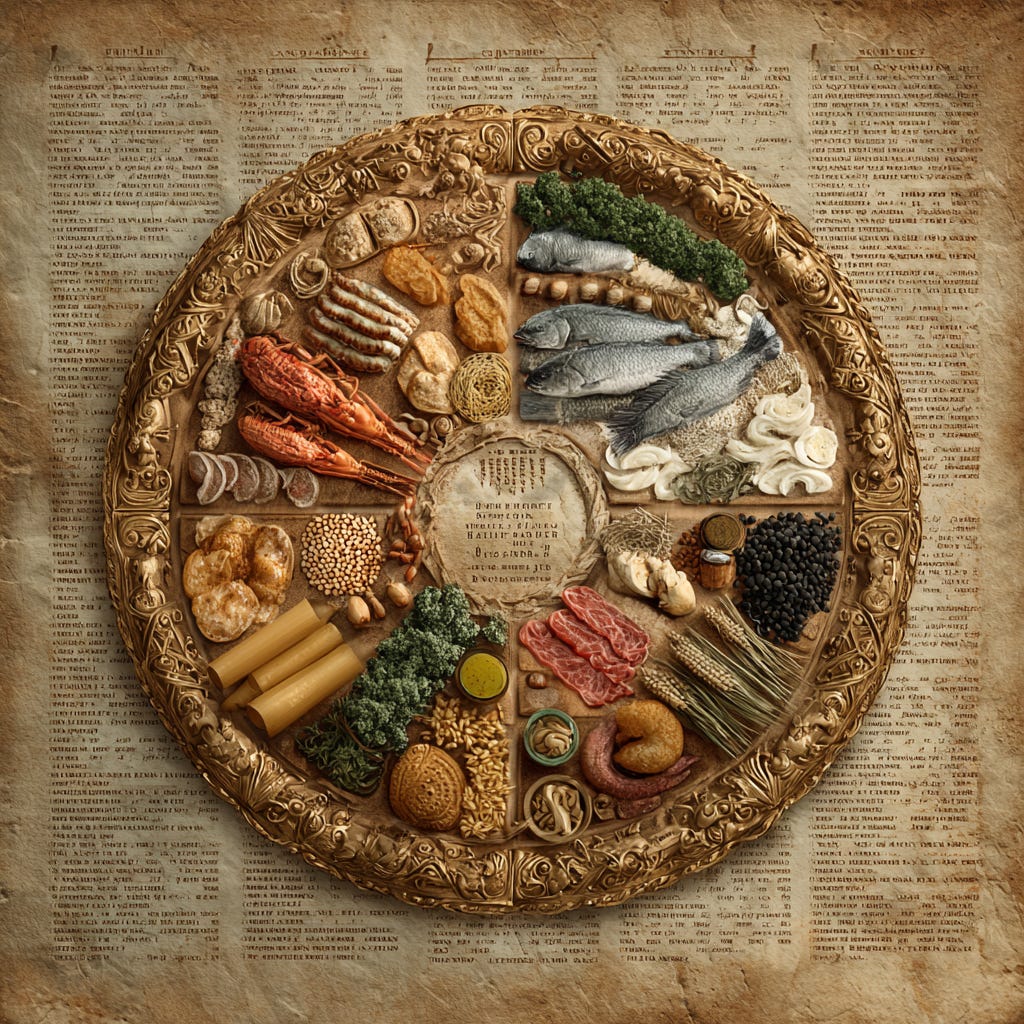
What the Codex Alimentarius Is, What It Does, and Why the Covenant Community Needs to Understand Both

RESILIENCE ON THE ROAD TO REVELATION
Volume 3: The Seven Bowls | Special Supplemental
The Codex Alimentarius — Latin for “Food Code” — is not a household name. But it governs more of what appears on your plate, in your medicine cabinet, and in your nation’s food import and export regulations than most people realize. It is a real institution, established by real documents, administered by a real commission, and referenced by the World Trade Organization in real trade disputes that affect real nations’ abilities to set their own food safety standards.
The covenant community’s preparedness framework requires understanding it accurately — neither dismissing it as irrelevant bureaucracy nor overstating what the documentation actually shows. The documented evidence is sufficient.
“He that tilleth his land shall be satisfied with bread: but he that followeth vain persons is void of understanding.” — Proverbs 12:11, KJV
“For the love of money is the root of all evil: which while some coveted after, they have erred from the faith, and pierced themselves through with many sorrows.” — 1 Timothy 6:10, KJV
WHAT THE CODEX ALIMENTARIUS ACTUALLY IS
The Codex Alimentarius Commission was established in 1963 by the Food and Agriculture Organization of the United Nations and the World Health Organization. It currently comprises 188 member countries, one member organization (the European Union), and more than 230 observers including intergovernmental organizations, NGOs, and UN agencies — representing approximately 99% of the world’s population.
Its stated purpose: to protect consumer health and promote fair practices in international food trade through the development of international food standards, guidelines, and codes of practice.
The Codex Alimentarius covers all foods — processed, semi-processed, and raw. Its standards address food additives, pesticide residues, veterinary drug residues, contaminants, labeling, food hygiene, and the safety of foods derived from modern biotechnology. As of 2017, the Commission had produced 78 guidelines, 221 commodity standards, 53 codes of practice, and 106 maximum levels for food contaminants.
Importantly: the Codex Alimentarius does not have direct regulatory authority. It is a reference document, not a self-executing law.
THE WTO CONNECTION — WHERE THE TEETH ARE
The Codex Alimentarius’ practical power derives not from direct enforcement but from its formal relationship with the World Trade Organization.
The WTO’s Agreement on Sanitary and Phytosanitary Measures — the SPS Agreement — names the Codex Alimentarius as the international reference point for food safety. The implication is precise and documented: WTO member nations that wish to apply stricter food safety measures than those established by Codex standards must scientifically justify their departure. If they cannot provide sufficient scientific justification, they may face WTO trade dispute proceedings.
This is the mechanism through which a non-regulatory reference document acquires functional authority over national food policy. A nation that wants to ban a food additive, restrict a pesticide residue, or require labeling that exceeds Codex standards must prove its case against an international scientific standard — or risk losing a WTO trade dispute. The burden of proof falls on the nation seeking stricter protection, not on the party seeking market access.
For the series’ Agricultural-Food Security spoke, this is the critical institutional connection: the Codex Alimentarius is the international floor for food standards, and the WTO’s trade dispute mechanism is the enforcement architecture that makes that floor difficult to build below.
THE PHARMACEUTICAL INDUSTRY CAPTURE — A DOCUMENTED CASE STUDY
The single most significant documented example of institutional capture in the Codex Alimentarius’ history is the 1996 German proposal on nutritional supplements.
In 1996, the German delegation to the Codex Alimentarius Commission — sponsored by three German pharmaceutical firms — put forward a proposal that no herb, vitamin, or mineral should be sold for preventive or therapeutic reasons, and that supplements should be reclassified as drugs rather than as food.
The proposal was agreed upon within the Commission process. Public protests and sustained advocacy from natural health communities in multiple countries ultimately halted its full implementation. The 28th Session of the Commission (2005) subsequently adopted Guidelines for Vitamin and Mineral Food Supplements that, while more moderate than the 1996 proposal, established Codex-level guidelines for supplement regulation that continue to influence national regulatory frameworks.
The pattern this episode documents is significant for the series’ framework: a regulatory body established for consumer protection can be used by pharmaceutical industry interests to restrict access to nutritional alternatives that compete with pharmaceutical products. The institutional vehicle was international. The sponsorship was commercial. The mechanism was the same regulatory harmonization process that the Codex Alimentarius uses for legitimate food safety purposes.
This is not conspiracy. It is documented institutional capture — the same pattern the series documents throughout the Mercury domain’s five-layer stack and the Bilderberg closed-room governance documentation.
THE AGRICULTURAL-FOOD SECURITY SPOKE — THREE CODEX IMPLICATIONS
Implication 1 — Pesticide residue harmonization:
Codex maximum residue limits for pesticides become the WTO reference point. Nations seeking to restrict pesticides that exceed Codex limits — based on their own precautionary principles or independent scientific assessment — bear the burden of scientific justification in WTO dispute processes. This creates structural pressure toward harmonization at Codex levels rather than allowing nations to apply stricter domestic standards without trade consequences.
For the covenant community’s food sovereignty posture: the practical implication is that the global industrial food system’s pesticide use is defended at the international level by the same standards that govern what your nation can require of imported food.
Implication 2 — GMO and biotechnology standards:
The Codex Alimentarius contains risk assessment procedures for foods derived from modern biotechnology — including DNA-modified plants and micro-organisms. Codex’s biotechnology standards influence the international trade framework within which GMO labeling and restriction policies are evaluated. Nations seeking mandatory GMO labeling or GMO import restrictions face Codex-referenced challenges in WTO dispute proceedings.
The series’ imago Dei / taxonomy insertion for RET Volume 3 documents the broader philosophical framework of which GMO agriculture is the practical institutional expression: the systematic transgression of Genesis min kind-boundaries through commercial agricultural technology, protected by international trade law.
Implication 3 — Supplement and nutrient regulation:
The 1996 pharmaceutical industry proposal and the 2005 supplement guidelines document a consistent direction: the movement of nutritional supplements from food toward drug regulatory frameworks. Under drug regulatory frameworks, the burden of proof for market access reverses — instead of being presumed safe until shown harmful (food standard), products must demonstrate safety and efficacy through clinical trial processes (drug standard) before they can be sold.
The practical implication for the covenant community: the nutrient-dense food and supplement resources that Tennant’s voltage restoration framework, Pollack’s EZ water maintenance, and the series’ seven voltage restoration practices identify as foundational to health are subject to an ongoing institutional pressure that moves their availability from food stores toward pharmaceutical gatekeeping.
THE HUMAN-CULTURAL SPOKE — FOOD SOVEREIGNTY AS COVENANT FAITHFULNESS
The Human-Cultural spoke of the Resilience Wheel addresses the cultural and social fabric that sustains community identity and covenant faithfulness across generational time. Food is not peripheral to this spoke. It is foundational to it.
Every culture in human history has defined itself in part through its relationship to its food — what it grows, how it prepares it, what it considers clean and unclean, what it offers at its tables and its altars. The covenant community’s relationship to food is explicitly theological: the Levitical food laws, the Passover meal, the Lord’s Supper, the communion table. These are not incidental to covenant identity. They are expressions of it.
The Codex Alimentarius represents, in institutional form, the pressure toward the homogenization of that relationship — the replacement of diverse, culturally embedded, locally sovereign food systems with a globally harmonized standard administered by a commission that 99% of the world’s population is a member of, but in which the interests of industrial food producers, pharmaceutical companies, and trade facilitation consistently carry institutional weight.
The Babel project was a project of enforced uniformity — a single language, a single city, a single governance system. The covenant community that the Noahide Laws post documented as subject to a universal legal framework is the same covenant community whose food system is subject to a universal standards framework. The pattern is consistent because the driver is consistent.
This is not alarmism. It is pattern recognition applied to documented institutional evidence.
THE RESILIENCE RESPONSE — SEVEN FOOD SOVEREIGNTY PRACTICES
The covenant community’s response to the Codex Alimentarius framework is not political activism against an international body. It is the practical, daily building of food systems that reduce dependence on the globalized industrial food architecture the Codex governs.
1. Know your soil. The Codex governs commercially traded food. It has no jurisdiction over food you grow in your own soil. Build soil health through organic matter, compost, and nitrogen-fixing cover crops — and what you produce at home operates entirely outside the international standards framework.
2. Know your farmer. Direct relationships with local farmers and producers — purchased at farm gates, farmers markets, and CSA arrangements — operate largely outside the international trade framework the Codex governs. Knowing your food producer personally is a sovereignty practice.
3. Source heirloom and open-pollinated seeds. The seed sovereignty issue — addressed in the nuclear cascade post — intersects directly with Codex biotechnology standards. Heirloom and open-pollinated seeds are not patented, not GMO, and not subject to the seed licensing frameworks that the international biotechnology trade architecture enforces.
4. Maintain your own nutritional supplement supply. The documented pharmaceutical industry pressure on supplement regulation makes maintaining a personal supply of key nutritional supplements — particularly those supporting cellular voltage restoration, mineral balance, and immune function — a practical sovereignty measure. The direction of institutional travel on this issue is documented.
5. Learn food preservation. Fermentation, dehydration, canning, and lacto-fermentation are food preservation traditions that predate and operate entirely independently of the industrial food system and its international regulatory framework. They are also the nutritional practices that produce the most bioavailable mineral and probiotic content.
6. Understand what you are eating. The Codex Alimentarius governs food additives, pesticide residues, and contaminants. Eating food that has no additives and no pesticide residues — whole, unprocessed, locally grown food — removes your daily nutrition from the additive and residue framework entirely.
7. Pray over what you eat. This is not a pious addition to a practical list. It is the foundational practice. The covenant community’s food sovereignty begins at the table where we acknowledge that every good and perfect gift comes from the Father of lights — not from a commission in Rome.
“For every creature of God is good, and nothing to be refused, if it be received with thanksgiving: For it is sanctified by the word of God and prayer.” — 1 Timothy 4:4-5, KJV
【 THE BOTTOM LINE 】
The Codex Alimentarius is a real institution with documented food safety functions and documented institutional capture by pharmaceutical and industrial food interests. Its relationship with WTO trade dispute mechanisms creates real pressure on national food sovereignty. Its supplement regulation history documents real pharmaceutical industry influence on international food standards.
The covenant community does not respond with alarm. It responds with the practical food sovereignty framework the Resilience Wheel’s Agricultural-Food Security and Human-Cultural spokes have always described: grow what you can, know your farmer, preserve your food, maintain your nutritional independence, and receive everything at your table with thanksgiving.
The globalized food system’s governance architecture was always going to reach this institutional expression. The covenant community’s response was always going to be the same: come out of the dependency before the dependency fails.
Even so, come Lord Jesus. Maranatha.
© 2026 R3 Publishing LLC. Resilience on the Road to Revelation: Volume 3 — The Seven Bowls. resilienciero.substack.com
“All we need to know can be found in Scripture.” — Edward May, Fifth Watchman
Primary sources: Codex Alimentarius Commission official documentation (fao.org); WTO SPS Agreement; Wikipedia Codex Alimentarius entry; FAO Understanding the Codex Alimentarius historical documentation.