
Saturn Shabbatai
The Black Sun, the Sabbath Gospel, and What the Ancients Encoded in the Night Sky

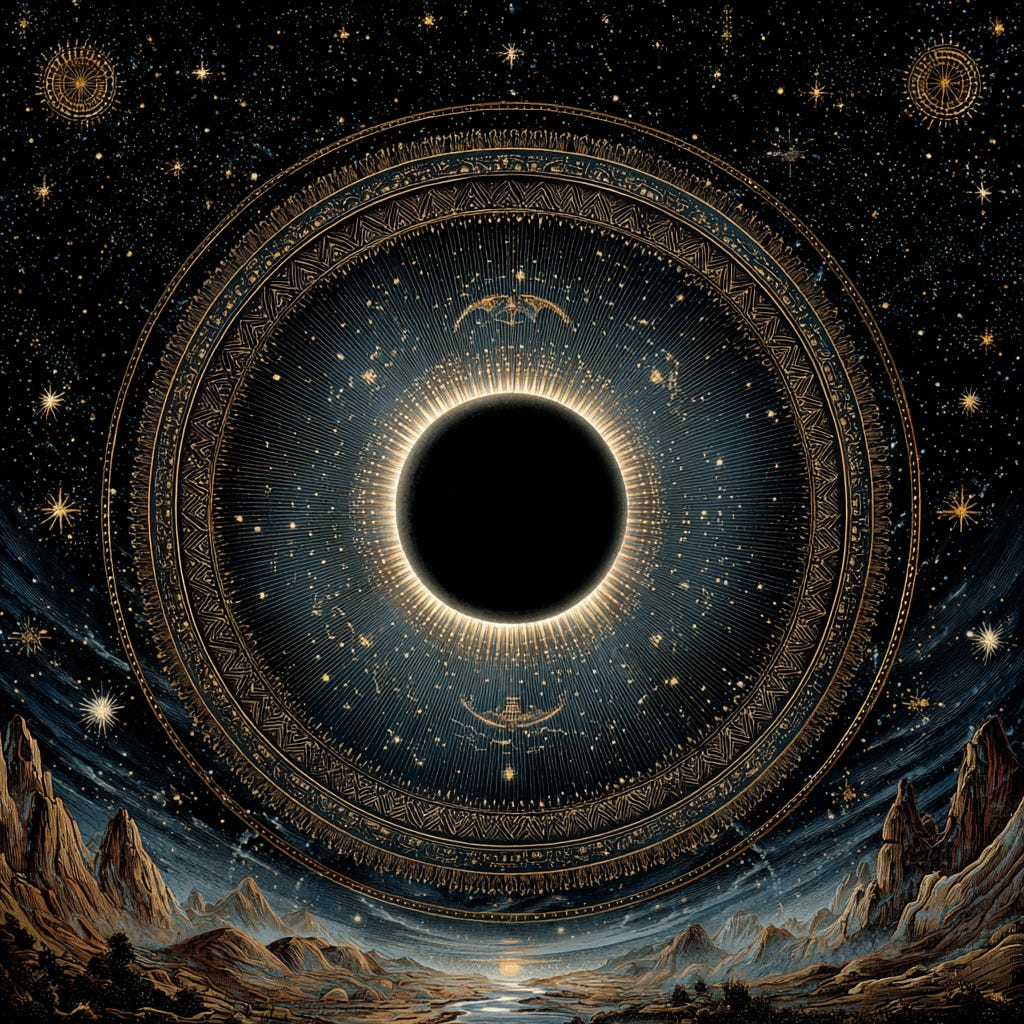
The Mazzaroth: God’s Gospel in the Stars | Special Edition
mazzaroth.world | resilienciero.substack.com
© 2026 R3 Publishing
“Which commandeth the sun, and it riseth not; and sealeth up the stars. Which alone spreadeth out the heavens, and treadeth upon the waves of the sea. Which maketh Arcturus, Orion, and Pleiades, and the chambers of the south.” — Job 9:7-9 (KJV)
“Remember the sabbath day, to keep it holy.” — Exodus 20:8 (KJV)
The Gospel Written Before the Alphabet
The Mazzaroth series is built on a foundational claim: before human history began, before a single prophet spoke or a single scroll was written, God inscribed the Gospel in the stars.
“The heavens declare the glory of God; and the firmament sheweth his handywork. Day unto day uttereth speech, and night unto night sheweth knowledge. There is no speech nor language, where their voice is not heard.” — Psalm 19:1-3 (KJV)
No speech. No language. The Gospel proclaimed in the universal language of the night sky, to every people on earth, since the first star was named.
This Special Edition examines the planet that ancient astronomers named most carefully of all — the planet whose Hebrew name encodes the Sabbath, whose ancient descriptions preserve the memory of the original creational rest, and whose comparative mythology independently confirms what the Volume 5 framework derives from Scripture.
The planet is Saturn. The Hebrew name is Shabbatai. And the ancient world knew exactly what it was encoding.
I. Shabbatai — The Name Itself Is the Gospel
In Hebrew, Saturn is called Shabbatai — from Shabbat, the Sabbath. The planet of rest. The planet of the completed work. The planet whose very astronomical name declares what the Sabbath declares: it is finished.
The Hebrew astronomers who named Saturn Shabbatai were working within a cosmological framework that understood the planetary domains as administrative expressions of divine realities. The planet assigned to the seventh position in the traditional planetary week — Saturday, Yom Shabbat, the Sabbath day — bears the name of the completed rest because the domain Michael administers is the domain of time as gift.
In the Volume 5 framework:
Saturn’s corrupted domain: time-as-weapon — compound interest, calendar theft, debt mechanics
Saturn’s original domain: time-as-gift — the Sabbath, the Sabbatical year, the Jubilee
The ancient Hebrew astronomers encoded this theology into the planet’s name. Every time a Hebrew child learned the name of the sixth planet — Shabbatai, the Sabbath star — they were learning that the heavens proclaimed the Sabbath covenant. The Gospel in the stars: even the night sky declares that time belongs to God, not to the debt system.
II. The Resting Planet — Ancient Descriptions Confirm the Name
The comparative mythology research of saturniancosmology.org, drawing on Talbott’s The Saturn Myth (1980), documents how Saturn was described across ancient cultures in language that precisely mirrors the Sabbath theology encoded in its Hebrew name:
In Akkadian/Sumerian: Saturn was called Sag Us — the “steady planet.” The planet that does not move. The planet at rest.
In Babylonian: Saturn is called Shabbath — cognate with the Hebrew Sabbath. Not borrowed. Both traditions independently preserving the same ancient theological encoding of Saturn as the planet of completed rest.
In Egyptian: The Papyrus of Ani addresses the deceased entering heaven: “O thou who art without motion like unto Osiris!” — repeated twice. Osiris, associated with Saturn in Egyptian cosmology, is praised for his stillness. Even Ra is lauded as he “who dost lie without movement.”
The planet without motion. The steady planet. The planet of rest. The Sabbath star.
Across Akkadian, Babylonian, Hebrew, and Egyptian sources — independently — Saturn is the resting, unmoving, completed body in the sky. The night sky has been proclaiming Shabbat since the first astronomer named the sixth wandering star.
III. The Primeval Polar Light — What the Ancient World Saw
Comparative mythology documents a tradition appearing across Egyptian, Norse, Indian, and Central Asian sources: the memory of an original sun — a primeval luminous body that preceded the current solar order, fixed at the celestial north pole, beneath which humanity lived in paradise.
In the ancient world’s memory, before the current solar order was established, Saturn occupied the position of the primary luminous body at the celestial north pole — described across cultures as Earth’s original sun, the unmoving light of the golden age that preceded the current fallen world.
The Norse sources call it the sun that never set — the eternal northern light. The Egyptian sources describe the sun of the night, the sun that was before the day. The Indian sources preserve it in the Kali Yuga — the lost golden age. The Mesoamerican sources encode it in the first and second “creations” that preceded the current world age.
What does this mean for the Mazzaroth? If Saturn occupied a dominant position as Earth’s primary luminous body before the current solar order — whether in the pre-Adamic Eden One era or in a post-Flood transitional period — then Saturn’s astronomical Gospel encoding is not merely the Gospel of one minor wandering star. It is the Gospel of the original light-giver, proclaiming the Sabbath theology written into creation before the current sun ever rose.
This is what Michael’s Saturn domain looked like in its unfallen original expression: the primeval light of Eden One, the original covenant time flowing from the mountain of God at Jerusalem to all creation.
A Note on Saturn Symbolism and the Counterfeit:
The reader of the Revelation Exo-Truth series will recognize that the fallen administration has marked its stolen Saturn jurisdiction with specific symbols throughout modern history — from the Fraternitas Saturni’s 33° initiation system, to Himmler’s SS Schwarze Sonne (Black Sun) mosaic at Wewelsburg Castle, to Klaus Schwab’s WEF uniform bearing that same emblem. The Revelation Exo-Truth series documents this institutional chain correctly as the fallen administration’s ownership claim on a stolen domain.
What those symbols claim as theirs is real. The Saturn domain was the primeval light of Eden One. The theft is real. The counterfeit symbol is the fallen administration’s declaration that it possesses what Michael’s domain originally was — the Sabbath covenant, the Jacob’s Ladder, the primeval light of creation. They named their symbol after what they stole. Bowl 3 serves the eviction notice. The Seventh Eden restores what was taken.
IV. The Seven Companions and the Gospel of Completion
The Saturnian Cosmology research makes the identification that transforms comparative mythology into extraordinary theological confirmation:
“Ancient sources list seven ‘companions’ of Saturn... The God of the Bible is also accompanied by seven archangels.”
For the Mazzaroth series, this finding carries specific significance. The Mazzaroth’s Gospel-in-the-stars proclamation is built on the principle that God encoded the redemptive plan in the astronomical structure of creation before human history began.
If the seven visible satellites of Saturn encode the seven archangels — if the night sky displays the seven-fold administrative structure of the Saturn domain — then the Mazzaroth’s planetary Gospel layer is even richer than the stellar Gospel layer. Not only do the twelve constellations proclaim the redemptive story, but the planetary bodies themselves proclaim the administrative architecture of the covenant.
Saturn with its seven companions: the domain of the Sabbath, attended by the seven-fold archangelic administration, proclaiming the completed work of God.
The seven companion satellites of Saturn are a permanent astronomical inscription of the seven Spirits before the throne (Revelation 1:4) — written into the solar system itself by the King of Kings who created it.
“The heavens declare the glory of God.” Indeed. Right down to the administrative structure.
V. Shabbatai and the Completed Work of Christ
The Sabbath, in its deepest biblical meaning, is not merely a day of rest. It is the declaration of a completed work.
“Thus the heavens and the earth were finished, and all the host of them. And on the seventh day God ended his work which he had made.” — Genesis 2:1-2 (KJV)
The New Testament application in Hebrews 4: the Sabbath rest remaining for the people of God is the rest of completed redemption — the finished work of the cross, entered by faith.
“For he that is entered into his rest, he also hath ceased from his own works, as God did from his.” — Hebrews 4:10 (KJV)
The Sabbath rest is not a day. It is a Person — the King of Kings whose completed work on the cross declared “It is finished” in precise Sabbath theology.
Shabbatai — the Sabbath star — has been proclaiming this Gospel in the night sky since the first morning stars sang together at creation. Every ancient culture that looked up and saw the sixth planet and called it the steady, resting, unmoving body was reading the same inscription that Hebrew astronomy encoded in the name Shabbatai: the planet of the completed work, the planet of rest, the planet whose domain proclaims the covenant of the King of Kings.
The King of Kings created the Sabbath as a sign of His completed creative work. He proclaimed the Sabbath as a covenant with His people. He fulfilled the Sabbath in His completed redemptive work on the cross. He will consummate the Sabbath in the eternal rest of the Seventh Eden — where “there shall be no night there” (Revelation 22:5) because the Sabbath that Shabbatai has been encoding in the night sky for six thousand years will have reached its eternal expression.
VI. The Mazzaroth Star Names of Saturn’s Domain
The Gospel in the names of the days of the week — the planetary layer operating in everyday human language:
Hebrew: Yom Shabbat (Sabbath day) — the day of completed rest
Akkadian/Sumerian: Sag Us / Shabbath — the steady, resting planet
Latin: Saturnus → Saturday — rest before the new week begins
English: Saturday — Saturn’s day
Every language that preserved the seven-day week preserved Saturn’s Sabbath theology in the name of the seventh day. Not just in the night sky but in the very calendar — in the name of the day on which billions of people rest each week, whether they know it or not — the Creator inscribed the Gospel of completed work.
This is the Mazzaroth’s planetary layer operating at the level of everyday human language. The fallen administration corrupted the calendar (documented in our 5-Part Prologue, Parts C and D). But it could not erase the name. Shabbatai is still written on Saturday. The Sabbath Gospel still speaks from the day’s own name.
VII. The Restoration — When Shabbatai Comes Home
In the Seventh Eden, Michael’s Saturn domain is restored to its original expression. Shabbatai — the Sabbath star — is no longer encoding the Gospel in the night sky for a world under fallen administration. It is the living reality of the completed work enjoyed in eternal rest.
The rings of Saturn — debris of Azazel’s corrupted administration — are gone. The Black Sun is no longer a memory preserved in mythology. It is the eternal Sabbath light of Michael’s restored domain, flowing from the Throne of God through the renewed creation.
The ancient world that preserved the memory of Saturn’s polar throne was reaching, however blindly, for what the Seventh Eden delivers: the completed rest, the gift of time returned, the Sabbath covenant of the King of Kings fulfilled forever.
“There remaineth therefore a rest to the people of God.” — Hebrews 4:9 (KJV)
The Mazzaroth has been proclaiming it since the morning stars sang together. Shabbatai has been declaring it in the night sky since the first Sabbath was kept. The Seventh Eden will be its eternal expression.
It is finished. And the finishing is forever.
© 2026 R3 Publishing. The Mazzaroth: God’s Gospel in the Stars. Even so, come Lord Jesus. Maranatha.
#Shabbatai #Saturn #Sabbath #Mazzaroth #GospelInTheStars #BlackSun #EdenOne #SevenArchangels #BirkelandCurrents #JacobsLadder #CosmicBackstory #R3Publishing #Maranatha